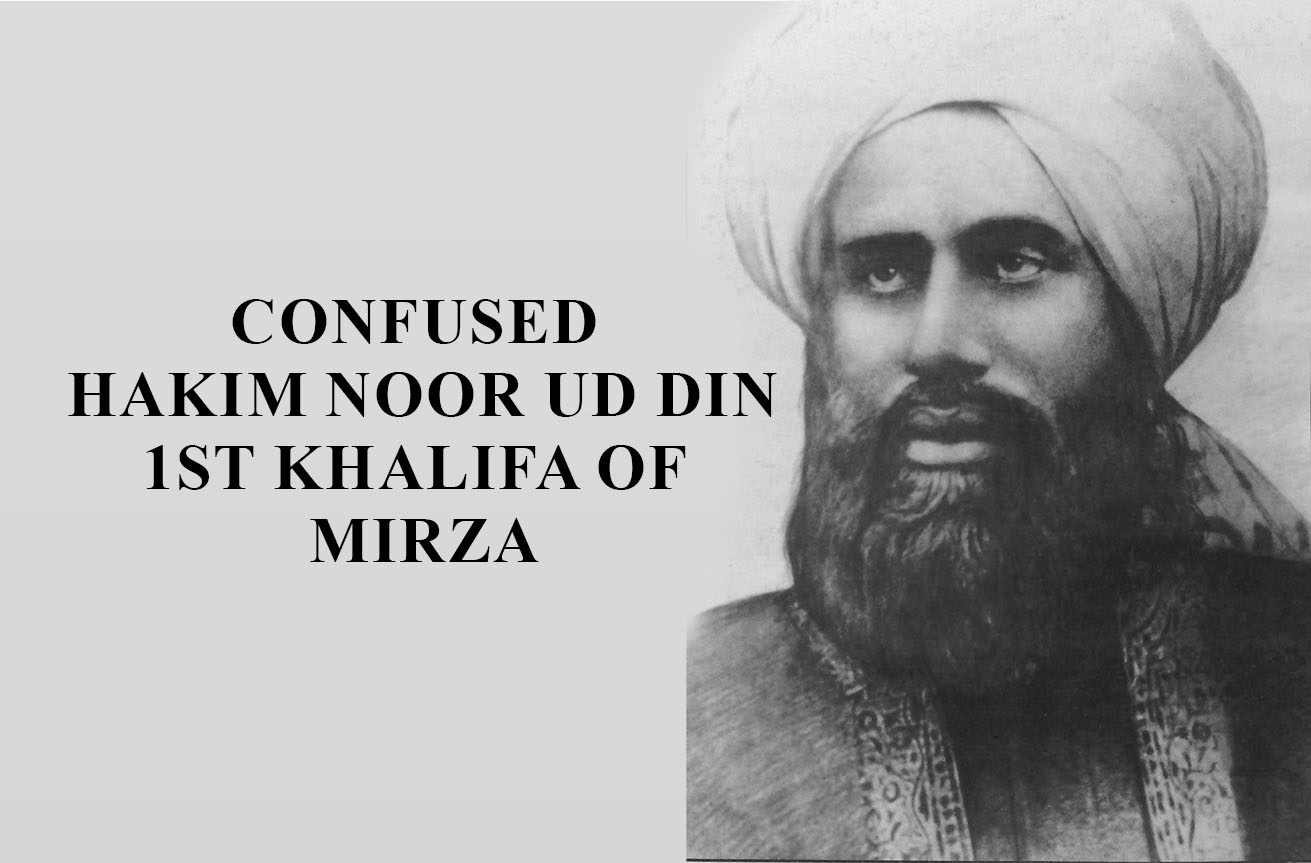
Hakim Noor ud din was the 1st Khalifa of Mirza Ghulam Ahmad and an important character of tareekh e ahmadiyyat. This piece of article describes his confused state of mind and temperament issues.
Khalifa Noor ud Din’s Inclination Towards Free Thinking
A study of life of Nuruddin (1st Khalifa of Mirza Ghulam Ahmad Qadiani) shows that he possessed a mercurial nature and remained a prey to mental conflicts during the greater period of his life. From the very beginning he had a bent towards “free-thinking”. First of all, he freed himself from the bonds of the four Muslim schools of jurisprudence and carried his non-conformism to an extreme.
Influence of Sir Sayyid Ahmad Khan on Noor ud Din
Then he came under the influence of Sir Sayyid Ahmad Khan’s literature and assimilated his way of thinking. This was the time when some elementary knowledge of physical sciences was finding its way to India and the rationalists among Indian Muslims were becoming deeply impressed by it, had a religious inclination alternated to Quranic teachings with scientific knowledge. If this harmonization presented any difficultly, they tried to overcome it by offering far-fetched interpretations of Quranic verses and the Quranic terminology. Nuruddin’s teaching of Tafsir was representative of this intellectual trend.[1]
Mirza Bashir Ahmad about Noor ud Din
In Sirat al-Mahdi, Mirza Bashir Ahmad writes:
“In the beginning Hazrat Nuruddin, the first Khalifah, was deeply under the influence of the way of thinking and the work of Sir Sayyid. But, subsequently, due to contact with Hazrat Sahib, this influence gradually wore off.”[2]
But a study of his ideas as well as those of his disciples makes it evident that either because of the influence of Sir Sayyid’s ideas, or because of his own predilection he remained the same all his life. His mind had been molded into a rigid frame and his mental attitudes had become too hardened to change.
Superstitious Element of Noor ud Din Personality
A more careful study of life of Hakim Noor ud Din reveals that along with his enlightenment and rationalism, there was a strong superstitious element in his personality. Despite all non-conformism and rationalism, he attached great importance to dreams and inspirations. It has been observed that not infrequently people who stand for intellectual freedom, in fact, for intellectual revolt, also have an inherent trait of superstitiousness. Their frame of mind is basically apologetic.
Conclusion
Such people keep on raising the banner of revolt all their lives against certain institutions or personalities, but, at the same time, when they submit before someone, their power of free-thinking and independent judgment is totally paralyzed. Man’s life is a strange combination of action and reaction; and his personality a complex of divergent, even mutually conflicting elements. Nothing is more difficult to understand and analyze than the driving urges of a man’s personality.
To read more about it, you can visit.
[1] A good example his way of thinking is found in the Tafsir of his pupil Maulavi Muhammad Ali Lahori (His Tafsir is found in English as well as Urdu).
[2]Sirat al-mahdi, Vol.1, p. 159., Riwayat 150 n.